Power Strips with Long Cords for Bedrooms: What Works
Power Strips with Long Cords for Bedrooms: What Works
Have you ever rearranged your entire bedroom just because the nearest outlet was in the wrong spot?
I did exactly that — moved a dresser nearly three feet so I could plug in a lamp and a phone charger without a cord running across the floor. Took an hour, looked fine for about a week, then I moved everything back because the room felt wrong. The outlet won.
The fix wasn’t moving furniture. It was getting a power strip with a cord long enough to reach from wherever the outlet actually is to wherever my devices need to be. Sounds obvious in hindsight. But most people don’t make that jump — they just keep working around the outlet until something goes wrong.
Why Bedroom Outlets Are Almost Never Where You Need Them
Residential electrical code requires one outlet roughly every 12 feet along any wall. Builders install the minimum, place them at knee height, and move on. That standard predates smartphones, wireless earbuds, smartwatches, electric toothbrushes, and the general explosion of things that need overnight charging. Nobody writing that code was thinking about a nightstand with a phone, a watch, earbuds, a reading light, and a Kindle all drawing power simultaneously.
The result: most bedrooms have outlets clustered near the door and at one or two points on the main wall. Your bed, desk, and dresser end up wherever the room’s dimensions and your preferences dictate — which is almost never next to those outlet clusters.
The bedroom is worse than other rooms for this reason: a bed is large and effectively dictates the room’s entire layout. Everything else — nightstands, dressers, desks — arranges around it. If the bed ends up on the wall opposite the outlet, every device on both sides of the bed is now far from power. No other room has a single piece of furniture this dominant over spatial decisions. A living room sofa can move. A queen bed in a 12-by-12 room has maybe two viable positions.
What People Actually Do When Outlets Don’t Reach
When an outlet is too far away, people improvise. Most of those improvisations are quietly hazardous:
- Daisy-chaining two extension cords together — each series connection multiplies resistance and builds heat at the junction point
- Using old, unrated cords pulled from a junk drawer, with no listed amperage rating and no surge protection whatsoever
- Tucking cords under rugs or carpet to hide them, which traps heat and slowly degrades insulation over months of continuous use
- Overloading a single outlet with a cube tap, then running a power strip off that, stacking failure points on top of each other
None of these cause immediate visible problems. The cord under the rug looks fine. The daisy-chained extensions work fine. Then one night they don’t. A single long cord from outlet to strip eliminates all of this — one continuous run, no series connections, no junction points accumulating heat where you can’t see them.
Why the Standard 6-Foot Strip Doesn’t Fix This
The average power strip comes with a 6-foot cord. That covers maybe one desk position if the outlet is directly behind it. It doesn’t help when your bed is against the opposite wall, when your nightstand is six feet from the nearest socket, or when your desk is tucked into a corner eight feet from the only outlet on that side of the room.
A 25-foot cord covers essentially any residential bedroom layout without a single extension cord. That’s the actual value — placement freedom. You stop designing the room around where the builder put the outlets and start putting furniture where it makes sense. The cord runs along baseboards and disappears. No visible crossings, no tripping hazards, no compromises on where your desk or bed goes.
The length also matters from a safety standpoint. One continuous cord from wall to strip is always preferable to two shorter cords in series. Every additional connection is a potential failure point. Long-cord strips remove the temptation to chain extensions together in the first place.
What Specs Actually Separate Safe Power Strips from Hazards
Power strips vary more than most people realize, and the differences matter when devices are running unsupervised near where you sleep.
| Spec | Minimum to Accept | What Good Looks Like | Why It Matters |
|---|---|---|---|
| Surge Protection | 1000 joules | 2700J–4000J | Higher joule rating absorbs more before protection quietly degrades |
| Cord Length | 10 ft | 25 ft | 25 ft reaches across most bedrooms without any extension cord |
| Outlet Count | 6 | 10–12 | Modern bedrooms average 7–9 devices needing power each night |
| USB-C Ports | 1 at 5W | 2 at 18W+ Power Delivery | Current phones, tablets, and laptops all charge primarily via USB-C |
| Plug Type | Standard 3-prong | Flat or angled | Flat plugs sit flush behind furniture instead of pushing it forward |
| Overload Protection | Basic fuse | Auto shutoff + fire retardant housing | Automatic cutoff prevents damage; fire retardant housing matters for overnight use |
Surge Protection: The Joule Rating People Skip Over
Surge protection is measured in joules — the total energy a strip can absorb across its lifetime. The component that does this work is called a metal oxide varistor, or MOV. It degrades with every surge it absorbs, large or small. Once depleted, the outlets keep working perfectly. The protection is just gone. You’d never know unless you check the indicator light on the strip’s housing.
For overnight bedroom use, don’t go below 2026 joules. A generic strip from a dollar store often has 200J or less — enough for maybe one meaningful surge before it’s effectively just an extension cord. The NTONPOWER surge protector version is rated at 4000 joules, which is substantial headroom for a home environment where most surges are small and repetitive rather than large and catastrophic. Make a habit of checking the indicator light every few months. When it goes dark, replace the strip — even if all the outlets still work perfectly.
USB-C in 2026: No Longer a Nice-to-Have
A few years ago, USB-C ports on power strips were mostly decorative — 5W output, slower than a 2026 wall adapter. The better strips now include USB-C with Power Delivery at 18W or higher. At 18W PD, you get real fast charging: an iPhone from dead to 50% in under 30 minutes, an iPad Air running at its full charge rate, a Nintendo Switch topping off while you play.
The iPhone 15 and 16 lines, Samsung Galaxy S24 and S25, every current iPad Pro and Air, and all recent MacBooks use USB-C as their primary or only port. A strip without at least two USB-C ports means you’re still hunting for cube adapters in a room that should be clean and minimal. The NTONPOWER 25 FT includes two USB-C ports alongside two USB-A — a full nightstand charging station without a separate dock taking up surface space.
The NTONPOWER 25 FT Power Strip: My Honest Take
Buy this one. At $39.99 with a 25-foot cord, 12 outlets, and two USB-C ports including Power Delivery, the NTONPOWER solves the bedroom outlet problem completely for less than comparable Belkin or Tripp Lite options with shorter cords.
I’ve used the AmazonBasics 12-outlet strip at a desk, the Tripp Lite Protect It! TLP1208TEL at a media setup, and the NTONPOWER at my bedroom workstation. The AmazonBasics does the job at close range but maxes out at 6 feet. The Tripp Lite feels built to last a decade and has excellent build quality, but it tops out at 8 feet and costs $55–$65. The NTONPOWER is the only strip I’ve used that let me place my desk exactly where I wanted it without any layout compromise or extension cord.
What the 25-Foot Cord Changes in Practice
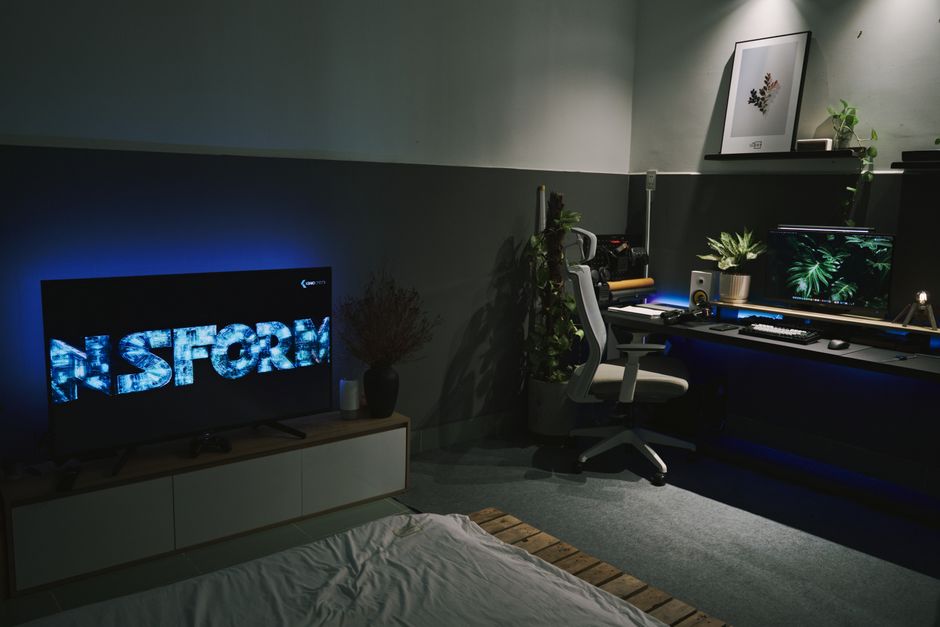
My bedroom outlet sits near the door. My desk is against the far wall — about 18 feet away. Every strip I’d tried before either came up short or required plugging into an extension cord, which adds exactly the kind of series connection I was trying to avoid.
“The 25ft cord makes it easily placeable anywhere not near an outlet,” one buyer noted — and that captures it precisely. The NTONPOWER runs along my baseboard for the full length of the room with cord to spare. No cords crossing open floor. No visible junction points. One clean run from door outlet to desk.
The three-sided outlet layout earns its keep. Bulky wall-wart adapters that would block two adjacent ports on a single-row strip fit cleanly here because they have room on each side. A verified reviewer specifically noted that “the plugs on the side help keep everything nice and clutter-free” — with a monitor, laptop, desk lamp, speaker, USB hub, and phone charger all running simultaneously, I still had outlets left over. “12 outlets is useful for a new computer set up,” another reviewer wrote, noting that “a long cord can help with managing multiple devices.” Both accurate.
The NTONPOWER 25 FT 12-outlet power strip is currently $39.99. For this cord length and outlet count with USB-C included, that’s well below what Belkin and Tripp Lite charge for equivalent or lesser specs. One reviewer put it directly: “It’s reasonably priced, making it accessible for most budgets without compromising on quality.”
The One Real Downside
It’s light. Noticeably light. “The lightweight construction makes it feel cheap,” one reviewer wrote — and that’s an accurate first impression. Pick it up out of the box and it doesn’t have the solid heft of a Tripp Lite. If you’re used to heavier commercial-grade strips, the initial feel is underwhelming.
For a bedroom desk or nightstand, this doesn’t matter in practice. The strip sits on a surface or mounts to a wall — you’re not moving it. The fire retardant housing and overload protection work as advertised. One reviewer confirmed it “comfortably carries enough power to drive a workstation PC, 3D printer setup, and a bunch of other smaller devices together” — that covers any bedroom or home office load I can think of. If you genuinely want something that feels premium in hand, the Tripp Lite TLP1208TEL has that reassuring weight. You’ll pay $15–$25 more for that feeling, and you’ll lose the cord length. For bedroom use, the NTONPOWER is the better call.
Flat Plug vs. Standard Plug: The Short Answer
If the outlet sits behind furniture — a bed frame, nightstand, or bookshelf — get the flat plug. Standard plugs extend 2–3 inches from the wall and push furniture forward. Flat plugs sit flush. That’s the entire decision.
The NTONPOWER flat plug surge protector runs $36.99 for 25 FT, 10 outlets, and 4 USB ports (2 USB-C) with 2700J of surge protection. The standard version gives you two additional outlets and a higher 4000J surge rating for $3 more. Both exceed what you actually need for bedroom use. Open wall outlet with nothing in front: standard 12-outlet version. Outlet tucked behind a headboard or nightstand: flat plug, no question.
Mistakes That Turn Power Strips Into Problems
- Daisy-chaining extension cords. Running one cord into another, or plugging a power strip into an extension cord, multiplies resistance and builds heat at each connection point. Most extension cord fires involve exactly this setup. One long cord from wall to strip — the whole reason to buy a 25-foot strip in the first place — is always the correct approach.
- Using power strips for high-draw appliances. A 1500W space heater draws 12.5 amps on a standard 120V circuit. The NTONPOWER is rated at 15A total. Run the heater through the strip and you’ve consumed 83% of its capacity before anything else is plugged in. Space heaters, portable air conditioners, electric kettles, and toaster ovens belong directly in wall outlets. This is not negotiable regardless of what strip you’re using.
- Running cords under rugs. It hides the cord and looks cleaner. It also traps heat and gradually degrades the cord’s insulation over months of continuous use. The damage is invisible right up until it isn’t. Run cords along baseboards instead. Use inexpensive cable raceways if you want a clean finish — they cost a few dollars and don’t create hidden thermal buildup.
- Assuming surge protection lasts indefinitely. Every surge protector has a finite joule capacity. Once absorbed through accumulated surges — large or small — the protection component is spent. The outlets keep working. The surge protection is gone. Check the indicator light on your strip periodically. When it goes dark, replace the strip even if every outlet still charges normally.
- Buying cheap strips for permanent setups. A $10 strip is fine for a single-day need. For a bedroom desk or nightstand that runs 24 hours a day, the absence of meaningful surge protection, automatic overload shutoff, and fire retardant construction means accepting risk you don’t need to accept. The NTONPOWER is $39.99. The Tripp Lite TLP1208TEL is $55. Both are designed for permanent installations. The $10 strip from a convenience store checkout aisle is not.
The right power strip handles the bedroom outlet problem cleanly — but it doesn’t make poor electrical habits safe. It just moves the outlet to where you need it.
Cord length solves placement. Surge joule rating solves protection. Get both right, and the rest takes care of itself.